Friday, September 7, 2018
Wecome Back!!!
Welcome to G&T 2018-19!!! This year will be filled with enriching and challenging adventures in Math, Engineering, and English Language Arts. G&T is a place where we can take risks, learn from both our successes and failures, ask lots of questions, persevere when faced with challenges, and, most importantly, have fun! For those of you who are new to the program, check out the videos below to get a feel for what this program is all about. For more info about each grade level, click on the grade level tabs above.

Friday, June 15, 2018
Final Weeks of School
The third graders have been exploring and writing new types of poetry like blackout poetry. They have also been practicing applying the poetic techniques we've learned to their own poems. Here are just a few examples of their work:

The fourth graders have been hard at work making a movie version of Shakespeare's Macbeth. We are thrilled with what we were able to put together in very little time. Check our our movies below!

The fourth graders have been hard at work making a movie version of Shakespeare's Macbeth. We are thrilled with what we were able to put together in very little time. Check our our movies below!
Our 5th graders held a second debate, and their debating skills were much improved! They were better at taking notes and refuting the other team's arguments. They also had a better grasp on the topic and were able to explain what their research meant!
Friday, May 18, 2018
Week of May 14-18
This week, my 3rd grade poets explored aspects of poetry like repetition, lists, surprising/descriptive language, and wonderings. We then tried to incorporate some of these things into our own poems. We discussed the importance of seeing the extraordinary in ordinary objects and seeing the world through a poet's eyes. I am so impressed with the sophisticated and thoughtful poems my students have been writing!
This week, the 4th graders took turns directing the first scene of "Macbeth." Watch how the decisions made by the directors affected how the scenes turned out!
This week, the 4th graders took turns directing the first scene of "Macbeth." Watch how the decisions made by the directors affected how the scenes turned out!
The 5th graders held their first formal debate. I was impressed with the research the students did in order to support their arguments! After reflecting on how it went, we agreed that we need to be better at taking notes throughout the debate in order to refute the other team's arguments.
Thursday, May 3, 2018
Weeks of April 23-May 4
Over the past couple of weeks, my 3rd grade poets explored aspects of poetry like repetition, lists, and surprising/descriptive language. We then tried to incorporate some of these things into our own poems. We discussed the importance of seeing the extraordinary in ordinary objects and seeing the world through a poet's eyes. I am so impressed with the sophisticated and thoughtful poems my students have been writing!
In 4th grade, we explored the language of Shakespeare and discussed his contribution to modern English. People back in Elizabethan times definitely spoke very differently than we do today, but after learning about verbs, pronouns, and some common terms from back then, we were able to start to make sense of it all! We also explored Shakespeare's Romeo and Juliet. After reading an abridged version, some students were surprised at how depressing this play actually is! We then focused on translating some of the balcony scene into modern day language by having Rome and Juliet text each other. I was shocked at how quickly many students were able to make sense of Elizabethan English and pick up on the gist of what was going on!
Our 5th grade debaters have been busy preparing for their first formal debate. They are making sure to have clear reasons to support their assertions and a lot of evidence to back up their ideas. The week after PARCC, we will hold the debates and evaluate how we did so we can make necessary improvements for the next one!
Our 5th grade debaters have been busy preparing for their first formal debate. They are making sure to have clear reasons to support their assertions and a lot of evidence to back up their ideas. The week after PARCC, we will hold the debates and evaluate how we did so we can make necessary improvements for the next one!
Friday, April 20, 2018
Week of April 16-20
This week, the 3rd graders continued to read and respond to poetry by participating in poetry stations. We painted the images poems created in our minds. We also hunted for poetic techniques we've been learning about in the books (both poetry books and short stories) scattered across the room. We really started to see how poetry is an art form; instead of paints, poets use words to make pictures or evoke feelings in their readers.


In 4th grade, we learned about Shakespeare's use of puns to entertain his audience. We explored the meanings of modern day puns and puns from some of Shakespeare's plays. The best part was coming up with our own puns! I was very impressed by how "punny" my students are!
Our 5th grade debaters continued to practice the art of refutation this week, and some classes also learned about critical literacy. We discussed how important it is to consider where information is coming from when doing research. Readers who use Critical Literacy read deeper into the information. They constantly ask: Why is this author telling me this information? What is their purpose? Are their opinions part of this source and does that make this a biased piece? Critical Literacy researchers are always looking for ways to assess a source’s credibility.


In 4th grade, we learned about Shakespeare's use of puns to entertain his audience. We explored the meanings of modern day puns and puns from some of Shakespeare's plays. The best part was coming up with our own puns! I was very impressed by how "punny" my students are!
Our 5th grade debaters continued to practice the art of refutation this week, and some classes also learned about critical literacy. We discussed how important it is to consider where information is coming from when doing research. Readers who use Critical Literacy read deeper into the information. They constantly ask: Why is this author telling me this information? What is their purpose? Are their opinions part of this source and does that make this a biased piece? Critical Literacy researchers are always looking for ways to assess a source’s credibility.
Friday, April 13, 2018
Week of April 9-13
This week, the 3rd graders read and responded to all types of poetry. We noticed that some poems rhyme, some use repetition, some use figurative language, some can be funny, and others can be pretty serious and emotional. We also read some Langston Hughes poems ("My People," "As I Grew Older," "I, too, sing America"), formulated open-ended questions about them, and had very interesting discussions. I was so impressed with my students' ability to see the universal themes of the poems that could relate to all of our lives!
After learning about life during the Elizabethan Era, the 4th graders read a modified version of Macbeth. They were shocked at how bloody and morbid it was! We will be working on putting on a kid friendly production of Macbeth during this cycle, so we chose our roles and started familiarizing ourselves with the script. We're really looking forward to making costumes, scenery, props, and learning how to direct scenes!
The 5th graders learned the art of refutation during our debate lessons this week. The four basic steps we followed are:
They say...
But I disagree. I believe...
Because...(reason and evidence)
Therefore... (prove why your argument is stronger)
We realized how important it is to do good research and really read through articles to find good supporting evidence!
After learning about life during the Elizabethan Era, the 4th graders read a modified version of Macbeth. They were shocked at how bloody and morbid it was! We will be working on putting on a kid friendly production of Macbeth during this cycle, so we chose our roles and started familiarizing ourselves with the script. We're really looking forward to making costumes, scenery, props, and learning how to direct scenes!
The 5th graders learned the art of refutation during our debate lessons this week. The four basic steps we followed are:
They say...
But I disagree. I believe...
Because...(reason and evidence)
Therefore... (prove why your argument is stronger)
We realized how important it is to do good research and really read through articles to find good supporting evidence!
Thursday, March 29, 2018
Week of March 26-29
This week, I was finally able to begin our ELA cycle! The 3rd graders were immersed in poetry. We read and discussed a wide variety of poems, looking at poetic techniques and meanings/messages of the poems. We learned ways to respond to poetry and took a try at it. We had many interesting discussions, like how the life and background of the poet affects his/her message. After reading about the Harlem Renaissance, Langston Hughes's poem "My People" made a lot more sense!
In 4th grade, students were transported back to the Globe Theatre during the Elizabethan Era. We explored the life and times of William Shakespeare and learned a lot about what life was like back then. The girls were not happy about the fact that girls back then did not go to school and could not act in plays! We discussed how the themes of Shakespeare's plays are still relevant today, which explains why he is still so well known!
The 5th graders became debaters, arguing the pros and cons of zoos. We learned that debates are formal arguments that are well organized and supported with reasoning and evidence. Debates are NOT people yelling at each other randomly using the knowledge that's already in our heads! We also started to practice constructing arguments using the A.R.E. format (assertion, reasoning, evidence). This will help us defend our claims in our debates!
In 4th grade, students were transported back to the Globe Theatre during the Elizabethan Era. We explored the life and times of William Shakespeare and learned a lot about what life was like back then. The girls were not happy about the fact that girls back then did not go to school and could not act in plays! We discussed how the themes of Shakespeare's plays are still relevant today, which explains why he is still so well known!
The 5th graders became debaters, arguing the pros and cons of zoos. We learned that debates are formal arguments that are well organized and supported with reasoning and evidence. Debates are NOT people yelling at each other randomly using the knowledge that's already in our heads! We also started to practice constructing arguments using the A.R.E. format (assertion, reasoning, evidence). This will help us defend our claims in our debates!
Friday, March 2, 2018
Week of February 26-March 2
This week, the 3rd graders learned what the term "stakeholder" means. We looked at the issue of the Keystone Pipeline XL from the viewpoint of various stakeholders that were both for and against the building of the pipeline extension. After doing some research, some students changed their original opinions on whether or not the pipeline was a good idea. Below, the students take on the roles of various stakeholders (TransCanada, environmentalist, Native American tribe leader, Nebraska landowner, and Omaha Federation of Labor president) and each make their case in a modified debate.


During our final week of Lego robotics, the students attempted various design challenges, like getting the robot to move without wheels or getting it to go up an incline. It was fun to see the students go through the engineering design process many times in order to meet their goals!
The 5th graders presented their final inventions/innovations that they came up with to solve real world problems. I was very impressed with the creativity and novelty of their inventions.
Thursday, February 15, 2018
Week of February 12-15
To sign up for conferences, click here: http://www.signupgenius.com/go/60B094AA8AA29A2FB6-spring
This week, the 3rd graders improved their oil spill cleanup process, thinking about what worked well and not so well during their first process so they could make adjustments. They learned that changing the order of their steps could affect their results and that it's important to maximize their budgets. Check out the before and after picture below to see how much one group was able to improve the process the second time around!

The 4th graders continue to add sensors and make their robots "smart." In the video below, the programmers use the touch sensor to change the direction of the robot. They also learned how to program the robot to multitask, or do more than one thing at a time!
This week, the 3rd graders improved their oil spill cleanup process, thinking about what worked well and not so well during their first process so they could make adjustments. They learned that changing the order of their steps could affect their results and that it's important to maximize their budgets. Check out the before and after picture below to see how much one group was able to improve the process the second time around!

 |
| These students carefully remove oil from a model river. |
The 4th graders continue to add sensors and make their robots "smart." In the video below, the programmers use the touch sensor to change the direction of the robot. They also learned how to program the robot to multitask, or do more than one thing at a time!
Now that we've explored other inventors' patents, it was time for the 5th graders to come up with their own inventions/innovations to patent. I was so impressed with the students' creativity. In doing research on previous inventions, we realized how difficult it is to come up with a novel idea, but that didn't stop us! Stay tuned for Shark Tank style pitches on these inventions in the coming weeks!
Friday, February 9, 2018
Week of February 5-9
This week, the 3rd grade environmental engineers continued to move through the engineering design process to imagine possible methods to clean an oil spill. After coming up with a couple ideas independently, they shared these ideas with their team members and came up with one plan to implement first. These plans are scored using 3 criteria: cost score (we have a budget of $20 million), shore score (whether oil reached the shore), and ecosystem impact score (how much oil was left in the river). After we evaluate our first processes, we will ask more questions about what worked well and what didn't work, and we will improve our designs.
In 4th grade, we are learning how sensors can allow the robot to make decisions or to do certain tasks based on input from the environment. Our robots can now sense reflected light, colors, angles, and distance from objects!
In 5th grade, we learned all about patents and how detailed they must be in order for them to be granted. The following website has tons of great resources that explain the patent process and give samples (many of which have been filed by kids)! Next, we will be creating our own inventions or innovations and patents for these inventions!
https://www.uspto.gov/kids/guides.html
In 4th grade, we are learning how sensors can allow the robot to make decisions or to do certain tasks based on input from the environment. Our robots can now sense reflected light, colors, angles, and distance from objects!
In 5th grade, we learned all about patents and how detailed they must be in order for them to be granted. The following website has tons of great resources that explain the patent process and give samples (many of which have been filed by kids)! Next, we will be creating our own inventions or innovations and patents for these inventions!
https://www.uspto.gov/kids/guides.html
Monday, January 29, 2018
Week of January 29-February 2
This week, the 3rd graders investigated a real environmental mystery happening in the nearby town of Red Bank. The Navesink River had been experiencing higher than normal levels of bacteria caused by human and animal feces. We did some research to find out what was causing the problem and what is being done to solve it. We discovered that there were some leaking pipes causing human waste to go right into storm drains and eventually into the river. People are also not cleaning up after their pets, and rain brings this waste to the river. Things like chemicals from lawns and waste from farm animals are also part of the problem. One solution is to educate the citizens about the importance of cleaning up after pets and being careful with what they use on their lawns. Another solution is to introduce oysters back into the river because they naturally filter water.
Some 4th graders added color sensors to their robots this week and are exploring ways to change the robot's behavior based on the reflected light bouncing back from the color sensor. Some groups are also exploring how to to get the robot to do different things based on the specific colors it detects using a multiple switch.
The 5th graders designed a new invention made from a piece of their dismantled technology. Then they had to pitch the idea to investors - Shark Tank style! Check out one example below: the ThermoScoop!

Some 4th graders added color sensors to their robots this week and are exploring ways to change the robot's behavior based on the reflected light bouncing back from the color sensor. Some groups are also exploring how to to get the robot to do different things based on the specific colors it detects using a multiple switch.
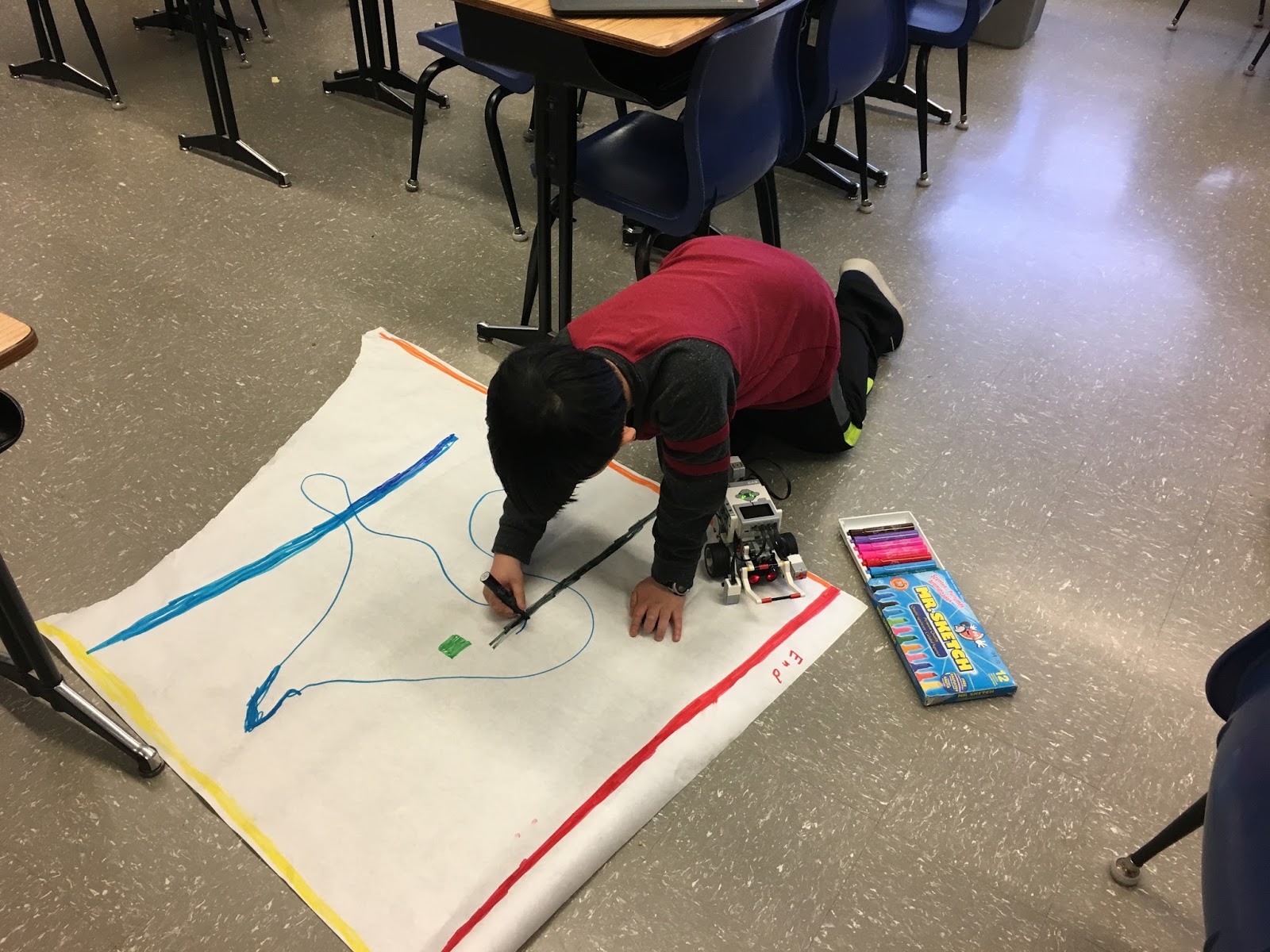 |
| The robot will use the color sensor to navigate through this obstacle course. |
The 5th graders designed a new invention made from a piece of their dismantled technology. Then they had to pitch the idea to investors - Shark Tank style! Check out one example below: the ThermoScoop!

Friday, January 26, 2018
Week of January 22-26
This week, the 3rd graders learned about how the materials we used in our model oil spill relate to materials used to clean a real world oil spill. We learned about how absorbent pads, skimmers, booms, in situ burning, bioremediation, chemical dispersants, shovels, and even alpaca hair wrapped in pantyhose can help contain and remove oil in the event of a real oil spill. We also discussed that many of these materials also come with some problems. For example, burning oil causes air pollution and using chemical dispersants is harmful to coral reefs.
The 4th graders were busy figuring out how to move the robot through an obstacle course, make it draw shapes and pictures, make it move objects from one place to another, use a loop to make it go around a baseball diamond, and much more!
 |
| This team programmed the robot to draw circles. |
The 5th graders had a blast dismantling technology and discovering all the circuits and parts that make it function! Then they came up with a new invention using a part of the dismantled technology. I was so impressed with the creative ideas the students came up with!


Friday, January 19, 2018
Week of January 16-19
This week, the 3rd grade engineers tested materials to see how well they contain and remove oil. Some materials worked very well to soak up the oil (nylon) while others soaked up water and repelled the oil (the sponge). With this knowledge, we will be able to make informed decisions when designing an oil spill clean up process.
The 4th graders continued to program their robots to do all sorts of things- make different types of curved moves (see video below), have the robot complete an obstacle course, go around a baseball diamond, move an object with an arm that lifts up and goes down, and much more! The students are doing a great job at understanding and explaining how the programming blocks afffect the robot's behavior!
 |
| 3rd graders test oil spill clean up materials |
In 5th grade, we discussed how some inventions (like the flushing toilet) were invented way ahead of their time, and they didn't have the supporting technology to make them really useful. We made a tech web to show all of the supporting technology necessary to make Gorilla Glass and other inventions successful, and we realized that many of these webs included electricity as a necessary supporting technology. We then did a little research about electromagents and how they are used in inventions and created our own electromagnet! After some experimenting, the students discovered that tighter coils made the electromagnet stronger.
 |
| These students used twice as much copper wire and a tight coil to make their electromagnet stronger! |
Friday, January 12, 2018
Weeks of January 2nd and January 8th
Our third graders were environmental engineers hired by Mayor Higgins of Greentown to investigate problems with animals and plants dying in the pond and garden. We used pH strips to test soil and water samples from various locations around town and compared this data to data taken three years ago. We noticed that some areas had become much more acidic, causing problems in the pond, while other areas had become more basic, causing harm to the garden. We then made visits to the locations in question to learn more about what was going on. Finally, we made recommendations to Mayor Higgins about how to solve these problems and prevent future problems with the ecosystem in Greentown.

One 5th grade class also started to take apart old pieces of technology in order to see what's inside. You can see them in action taking apart a calculator and headphones!


 |
| samples we tested with pH strips |
In 4th grade, we learned a lot more about how the programming blocks work. We learned that making the power negative moves the robot backwards, while making the steering negative makes the robot move left. Some groups began learning about the various types of turns the robot can make by adjusting the power of the left and right motors.
Our 5th graders learned about the 4 steps in the inventive process: idea, invention, innovation, improvement. Our challenge was to take the invention of cardboard and create an innovation and improvement using that invention. I was so impressed with the amazing inventions the students came up with: a stool that actually works, a hockey game, a bowling alley, a few puppet show theaters, shelving systems, a camping chair, a computer cooling station, and more! Each group was also able to improve their original innovations. For example, the camping chair creators added a part that pulls out to become a bed. Check out some of these innovations below!


Friday, December 22, 2017
Week of December 18-22
***Calling all 5th grade inventors!!! The 2018 Young Scientist Challenge is now open! Click HERE to find out how to enter.***
This week, the 3rd graders learned about ecosystems. We created a model food web to show how the living and nonliving things in an ecosystem are connected. Every single organism in our web was connected to the river in some way. This helped us understand how much devastation an oil spill can cause!
In 4th grade, we worked on programming our robots to move straight (forward and backward) and some groups began exploring curved moves. We learned that there are different modes you can use to tell the robot what to do. For example, you can use degree mode, rotation mode, on for seconds, and more to move the robot a certain distance. We used our math skills to figure out that one rotation is equal to 360 degrees. Some groups even found the circumference of the wheel in order to figure out how to get the robot to go a certain distance!
In 5th grade, we went on an invention hunt around the school and identified inventions as either type II (known problem with unknown method to solve it and unknown solution - like fans) or type III (unknown problem with unknown method to solve it and unknown solution - like the Promethean Board). We discussed how inventors have to be observant problem-finders and think up ideas that people didn't even know they needed. Some classes then learned about the 4 steps in the inventive process: idea, invention, innovation, improvement. Our challenge was to take the invention of cardboard and create an innovation and improvement using that invention. We will continue to work on this after the break.
This week, the 3rd graders learned about ecosystems. We created a model food web to show how the living and nonliving things in an ecosystem are connected. Every single organism in our web was connected to the river in some way. This helped us understand how much devastation an oil spill can cause!
In 4th grade, we worked on programming our robots to move straight (forward and backward) and some groups began exploring curved moves. We learned that there are different modes you can use to tell the robot what to do. For example, you can use degree mode, rotation mode, on for seconds, and more to move the robot a certain distance. We used our math skills to figure out that one rotation is equal to 360 degrees. Some groups even found the circumference of the wheel in order to figure out how to get the robot to go a certain distance!
In 5th grade, we went on an invention hunt around the school and identified inventions as either type II (known problem with unknown method to solve it and unknown solution - like fans) or type III (unknown problem with unknown method to solve it and unknown solution - like the Promethean Board). We discussed how inventors have to be observant problem-finders and think up ideas that people didn't even know they needed. Some classes then learned about the 4 steps in the inventive process: idea, invention, innovation, improvement. Our challenge was to take the invention of cardboard and create an innovation and improvement using that invention. We will continue to work on this after the break.
Friday, December 15, 2017
Week of December 11-15
This week, our third grade engineers examined pictures of an ecosystem from 50 years ago and today. Their challenge was to notice what's changed and figure out why those changes have happened. We realized that the birds disappeared, and without birds to eat them, the insects and fish increased. This caused the plants to start to decrease. We learned that everything in an ecosystem is interconnected, and when one change occurs, many more changes happen as a result!
The 4th graders finished building their robots and began programming! We are starting to see how the blocks have different modes and parameters that affect the behavior of the robot. We are excited to see all the amazing things we can program our robots to do!
Our 5th grade inventors learned about Maslow's Hierarchy of Needs and how inventions come from trying to meet people's needs. We had a lively debate about what is more important: things we need to survive or things we need for happiness. We came to the agreement that our basic needs must be met first, but that happiness is also very important for our survival. We then tried to create inventions out of wood (popsicle sticks) to meet each level of human need.
The 4th graders finished building their robots and began programming! We are starting to see how the blocks have different modes and parameters that affect the behavior of the robot. We are excited to see all the amazing things we can program our robots to do!
 |
| Students are busy building their robots! |
 |
| Students create shelters, weapons, trophies, and more items to meet their tribe's needs! |
Friday, December 8, 2017
Week of December 4-8
This week began our engineering units! The third graders kicked off the cycle with an engineering design challenge, build a tower at least one foot tall to support a stuffed cow. The catch: they could only use 50 index cards and two feet of tape! We learned an important lesson; engineers fail all the time. The important thing is being able to learn from our mistakes! By the end of the challenge, we all had a better idea of how we could improve our designs by making the index cards into stronger shapes like triangles and cylinders. Check out our creations below!


In 4th grade, we held our probability carnival and got a chance to play each other's games. The students did a terrific job of making games that appeared fair but were actually slightly unfair. Check out some pics and video of the carnival below! We also started our engineering unit by talking about robots v. machines and some examples of real robots in our world. We are very excited to finish building and start programming our EV3 robots!
 |
| Shout-out to Reeti for making this hat! |

In 5th grade, we began our unit on inventions by thinking about qualities of a good inventor. We agreed that things like creativity, perseverance, and patience are just a few important qualities that an inventor should possess. We then learned about the differences between divergent and convergent thinking and debated when each one would be more useful. Finally, we took E. Paul Torrance's test of creativity by brainstorming uses of a paper clip (fluency), categorizing the items on our list (flexibility), choosing the most unique one (originality), and creating a one minute commercial to give a detailed description of the wacky use of a paper clip (elaboration). Go to our 5th grade page to see all of the commercials!

 |
| The pocket scratcher |
 |
| Does changing a flat tire require convergent or divergent thinking? |
Friday, December 1, 2017
Week of November 27-December 1
This week, the 3rd graders finally decided which movie studio to work for. After looking at a lot of data about movie ratings and profits, they all decided to work for Pixar. They used their data to explain that Pixar had better overall ratings and a higher net profit than Dreamworks in recent years. Their final project is to choose a career that they are interested in and show how math is used in that career by creating word problems for their classmates to share. This will be due next week (the first week of engineering).
In 4th grade, we finalized our carnival games, making sure they are slightly unfair so we can make a profit. Next week, we will invite students to come and play our games! We will also start our engineering unit on Lego robotics!
The 5th graders learned about piecewise functions that will allow different results based on what key is pressed. This will enable our player to move up when the up arrow is hit and down when the down arrow is hit. The remaining code to get our games working is shared on our 5th grade page. Click on the links below to play some of the games the students have created! More games will be added to our 5th grade page.
Zachary's game
Gabriella's game
In 4th grade, we finalized our carnival games, making sure they are slightly unfair so we can make a profit. Next week, we will invite students to come and play our games! We will also start our engineering unit on Lego robotics!
The 5th graders learned about piecewise functions that will allow different results based on what key is pressed. This will enable our player to move up when the up arrow is hit and down when the down arrow is hit. The remaining code to get our games working is shared on our 5th grade page. Click on the links below to play some of the games the students have created! More games will be added to our 5th grade page.
Zachary's game
Gabriella's game
Wednesday, November 22, 2017
Week of November 20-22
During this short week, the 3rd graders focused on the importance of analyzing data in order to make informed decisions. Now that we've looked at movie ratings and profits, we must figure out what this info tells us about each studio so we can make an informed decision about where to work!
The 4th graders worked on their carnival games. They made the games are slightly unfair, but they made sure that this won't be obvious to the players. Then, they played their own games to determine the experimental probability of winning and losing (see below)!


The 4th graders worked on their carnival games. They made the games are slightly unfair, but they made sure that this won't be obvious to the players. Then, they played their own games to determine the experimental probability of winning and losing (see below)!


Some 5th grade classes continued to work on getting their game elements to move, while 5c learned a new datatype that will help keep these images onscreen. This datatype is called a Boolean. It performs a test and evaluates to true or false. Some examples of functions that produce Booleans are: <, > , =, and, or.
I hope everyone has a wonderful and relaxing Thanksgiving!!!

Friday, November 17, 2017
Week of November 13-17
This week, some third graders learned about the difference between gross profits and net profits. They calculated the net profit of Pixar and Dreamworks movies by subtracting the budget from the gross profit. This will help us figure out which company is doing better financially. We also learned what it means to be "in the red." Soon, we will put all of this data together to decide which company to work for!
In 4th grade, we revisited the question: what makes a game fair? We realized that in order for a game to be fair, each play must have the same theoretical probability of winning. Students were then given the challenge of creating their own carnival game based on chance that is slightly unfair (carnival owners have to make a profit)! They must be able to prove that the game is unfair by calculating the theoretical probability of winning and losing. I can't wait to see what everyone comes up with!
 |
| This student is calculating the net profit of recent movies. |
In 5th grade, we finally got some of our video game elements to move! We definied functions that take in the danger's and target's x-coordinate and either add or subtract 50 in order to move it left or right. Now, the problem is that they fly off the screen and don't come back! Our next challenge will be to keep them onscreen!
Subscribe to:
Posts (Atom)